Showing posts with label Alarm devices. Show all posts

30 December 2019

Guide to audible signals from E2S Warning Signals (more will follow)

E2S manufacture an extensive range of alarm horns or sounders suitable for many applications. The efficiency of any audible signaling device depends on: the size and / or distance of the area to be covered, the background noise and the pattern & frequency of tone

How do I calculate the effective distance and coverage of an alarm sounder?

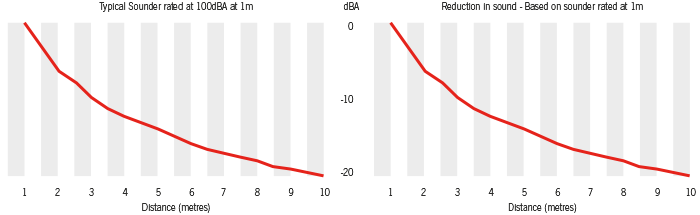
Loudness decreases as the listener get further from the source of the sound, mainly due to “divergence”. The intensity decreases because the energy is spread over a larger area. It decreases inversely with the square of the distance from the source at a rate of 6dB for each doubling of the distance. So the sound output from an alarm rated at 106dBA) will travel twice as far as a sounder rated at 100dB(A). If a sounder is rated at 100dB(A) at 1 meter, at two meters it will be 94dB(A), at 4 meters it will be 88dB(A) and so on.

Distance (meters)Reduction (dB(A))
10
2 (1m doubled)-6
4 (2m doubled)-12
8-18
16-24
32-30
64-36
128-42
256-48
512-54


How ambient background noise impacts on the effectiveness of the sounder
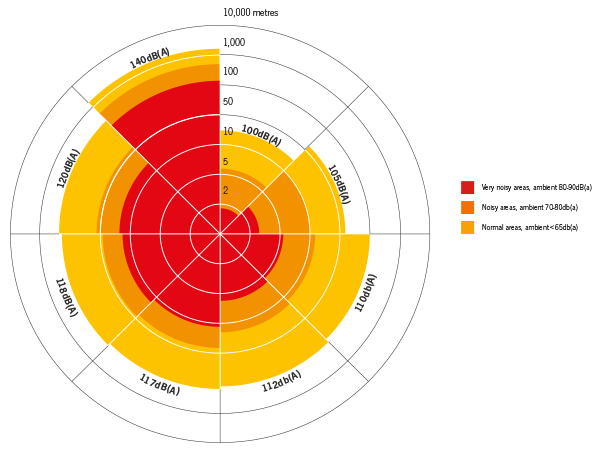
Note: The effective distance of a sounder is when the calculated dB(A) reaches at least 5dB(A) above the known ambient background noise. For example, the effective distance of a 100dB(A)@1 meter sounder in an ambient noise of 65dB(A) is the distance at which the sounder output level reduces to 70 dB(A) i.e. 100 dB – 30 dB = 70dB. From the above table (and using the inverse square rule) a reduction of 30 dB means the sounder has an effective 70dB distance of 32 meters.

A 120dB(A) @ 1-meter sounder has a 70dB distance of approximately 300 meters i.e. ten times the effective distance and, more importantly, 100 times the coverage area.


Remember
  • In the open, sound will spread in all directions. In an enclosed space some of the sounds will be reflected and increase the sound level.
  • All-mounted sounder is positioned near a ceiling, more sound will be reflected. The same is true for a ceiling-mounted sounder near a wall. 
  • A sounder mounted on a wall is more effective than one mounted on a pillar. 
  • Sounders should be sited to avoid immediate obstacles, ideally at a height of approx. 2 to 2.5 meters. 
  • Synchronized sounders will give a more effective overall effect. 
  • Personnel may be wearing ear protection.

08 December 2012

Audible signals in Security Systems


Audible signals warn, protect and guide us in the modern world. They indicate emergencies, malfunctions or dangerous situations and demand direct action. Think at the buzzer of an egg timer or the sirens for public danger.
 

Decibel (Loudness) Comparison Chart

Here are some interesting numbers, collected from a variety of sources that help one to understand the volume levels of various sources and how they can affect our hearing.
Environmental Noise
Weakest sound heard
0dB
Whisper Quiet Library
30dB
Normal conversation (3-5')
60-70dB
Telephone dial tone
80dB
City Traffic (inside car)
85dB
Train whistle at 500', Truck Traffic
90dB
Subway train at 200'
95dB
Level at which sustained exposure may result in hearing loss
90 - 95dB
Power mower at 3'
107dB
Snowmobile, Motorcycle
100dB
Power saw at 3'
110dB
Sandblasting, Loud Rock Concert
115dB
Pain begins
125dB
Pneumatic riveter at 4'
125dB
Even short term exposure can cause permanent damage - Loudest recommended exposure WITH hearing protection
140dB
Jet engine at 100', Gun Blast
140dB
Death of hearing tissue
180dB
Loudest sound possible
194dB

Environmental factors
In addition to the sound output level, the tone frequency and the distance to the signal device, environmental factors as wind, humidity, rain have an effect on audibility. A very important factor is the ambient noise level. In industrial environments in particular, the ambient noise level produced by machines is often very high. Accordingly, the signal devices must produce a sufficiently high sound output in order to be heard.